Most dog owners think about ticks as a deep-summer problem.
That is understandable, but it is not a great habit.
CDC guidance notes that tick exposure can happen year-round, even though ticks are most active during warmer months. AKC makes the same practical point for dog owners: once temperatures rise and outdoor time increases, ticks become a bigger threat fast.
So if your dog is spending more time in grass, brush, trail edges, parks, or even just a leafy neighborhood route, spring is the moment to tighten your routine—not wait until peak summer.
The good news is that the best post-walk tick check is simple. You do not need a 20-minute forensic exam. You need a repeatable system.
Why the “earlier than you think” part matters
There are two reasons owners get surprised by ticks:
- They associate risk with heat, not habitat.
- They underestimate how often dogs bring ticks home before anyone notices.
CDC specifically warns that pets can carry ticks into the house and that dogs should be checked daily if they go outdoors. AKC also recommends inspecting dogs even if they are already on a preventive product.
That second part matters. Prevention helps, but it does not replace checking.
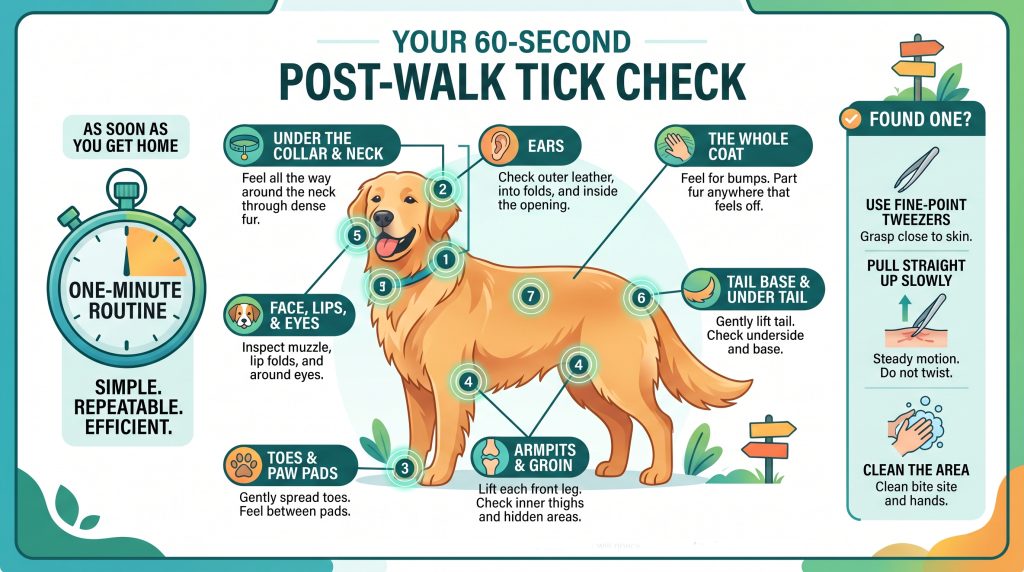
Your 60-second post-walk tick check
As soon as you get home, run your hands over your dog and feel for small bumps. Then check the places ticks love most.
1) Under the collar and around the neck
This is the big one for this article and honestly one of the easiest places to miss.
AKC specifically notes that ticks can attach under a dog’s collar and go unnoticed until they are large enough to be seen. If your dog wears a collar all the time, that hidden strip of skin can get overlooked for days.
What to do
- loosen or remove the collar briefly after the walk
- check all the way around the neck
- feel through dense fur, not just the visible surface
If you use a martingale, the same rule applies. Secure walking gear is great, but it also creates one more place where a quick check should become routine.
2) Ears—outside and inside
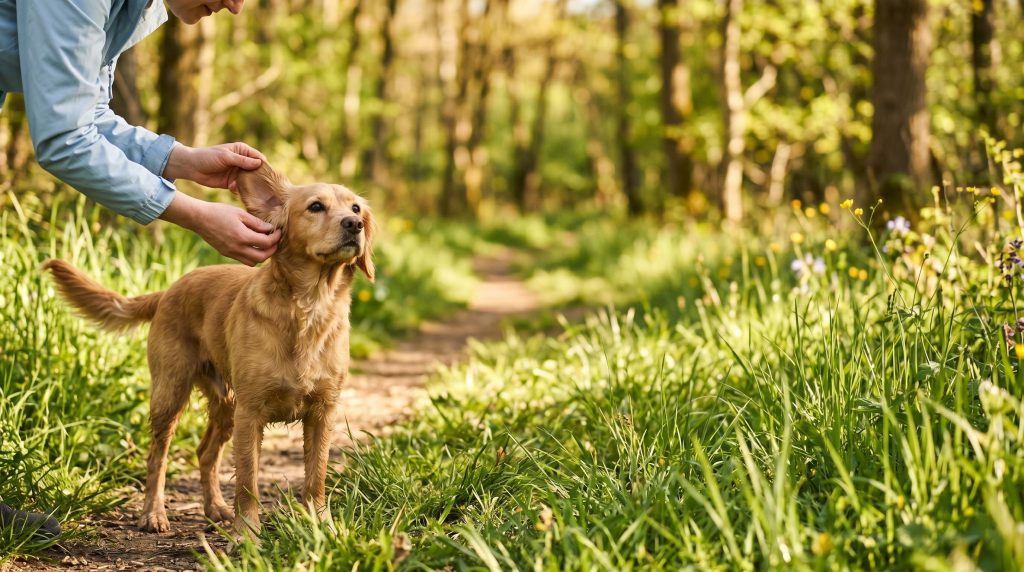
Ticks like creases, sheltered areas, and places owners do not inspect closely. AKC highlights ears as a common hiding spot, including deeper folds that are easy to miss.
What to do
- check the outer ear leather
- look into the folds
- if your dog tolerates it, inspect just inside the opening
Head shaking and ear scratching are not automatic proof of a tick, but they are good reasons to look.
3) Toes, paw pads, and between the toes
Dogs walk directly through the places ticks wait: grasses, edges of brush, low plants, and leaf litter. AKC repeatedly points owners to the feet and between the toes for a reason.
What to do
- spread the toes gently
- check between pads
- feel for small bumps or attached parasites
- watch for sudden paw licking or chewing after the walk
4) Armpits, groin, and under the legs
Warm, slightly hidden, and easy to ignore during a casual pet—these are classic tick zones. CDC and AKC both emphasize the need for thorough full-body checks, and AKC’s prevention guidance names under-leg areas specifically.
What to do
- lift each front leg briefly
- feel the armpit area
- check inner thighs and groin if your dog allows it calmly
You are not trying to make this a wrestling match. Steady, matter-of-fact checks work better than dramatic ones.
5) Face, lips, and around the eyes
A dog pushing their head into grass or brush can pick up ticks in places many owners do not think to inspect. AKC includes lips and areas around the eyes in its tick-check advice.
What to do
- inspect around the muzzle
- check lip folds carefully
- look around the eyes without poking or overhandling
6) Tail base and under the tail
Ticks like dark, protected areas. The underside of the tail and the area near the base are easy to forget unless you are looking on purpose.
What to do
- lift the tail gently
- check the underside and base
- part thicker fur if needed
7) The whole coat, especially after grassy or wooded walks
CDC advises checking pets daily and removing ticks promptly. AKC adds a useful practical step: feel for bumps all over the dog and part the fur anywhere something feels off.
That matters because a tick is not always sitting in one of the “usual” places.
What if you find one?
Do not panic, and do not go for folklore.
AKC recommends using fine-point tweezers to grasp the tick as close to the skin as possible and pull straight upward in a slow, steady motion. Avoid twisting or jerking, which can leave mouthparts behind.
Basic removal steps
- Part the fur so you can clearly see the tick.
- Grab it close to the skin with fine-point tweezers.
- Pull straight up slowly and steadily.
- Clean the bite area and your hands afterward.
- Monitor your dog over the following days and weeks.
CDC and AKC both emphasize prompt removal. The longer a tick stays attached, the more risk you are taking.
What not to do
- don’t crush it with bare fingers
- don’t yank fast and sideways
- don’t rely on old tricks like petroleum jelly, nail polish, or heat
- don’t assume “my dog is on prevention, so it can’t be a tick”
When to call your vet
Call your vet if:
– you cannot remove the tick fully
– the bite site becomes very irritated
– your dog seems unwell afterward
– you notice low energy, reduced appetite, lameness, fever, or behavior changes
CDC notes that signs of tickborne disease may not appear right away and can take days or longer. That is one reason checking behavior after a bite matters just as much as removing the tick itself.
Prevention still matters
Daily checks are great, but they are not the whole strategy.
CDC recommends talking to your veterinarian about the best preventive product for your dog and about the tickborne diseases common in your area. AKC says much the same: even with preventive products, dogs should still be inspected after walks in grassy or wooded places.
You can also reduce exposure by:
– staying more centered on trails
– avoiding brushy edges when possible
– mowing yard grass regularly
– cutting down leaf litter and overgrowth
A simple post-walk routine that actually sticks
Here is the version most owners can keep doing:
After every walk
- hands over coat
- under collar check
- ears
- feet and between toes
After grassy, wooded, or brushy walks
- add armpits, groin, face, and tail base
- check yourself too
Once a week in peak season
- do a slower, full-body check in good light
That is enough to catch a lot more than the occasional random glance.
Final thought
The point of a tick check is not to become paranoid. It is to become efficient.
Ticks are easiest to deal with when they are found early, removed properly, and followed by a little observation instead of denial. A one-minute check after walks is a lot cheaper—in stress and in vet bills—than discovering a problem days later under a collar you never thought to lift.
Sources
- CDC — Preventing Tick Bites: https://www.cdc.gov/ticks/prevention/index.html
- CDC — Preventing Ticks on Pets: https://www.cdc.gov/ticks/prevention/preventing-ticks-on-pets.html
- AKC — 7 Places to Look for Ticks on Your Dog: https://www.akc.org/expert-advice/health/places-to-look-for-ticks-on-dog/
- AKC — Keep Your Dog Safe From Fleas and Ticks With 11 Prevention Tips: https://www.akc.org/expert-advice/health/flea-and-tick-prevention-tips/
- AKC — How to Remove a Tick From Your Dog: https://www.akc.org/expert-advice/health/how-to-remove-tick-from-dog/