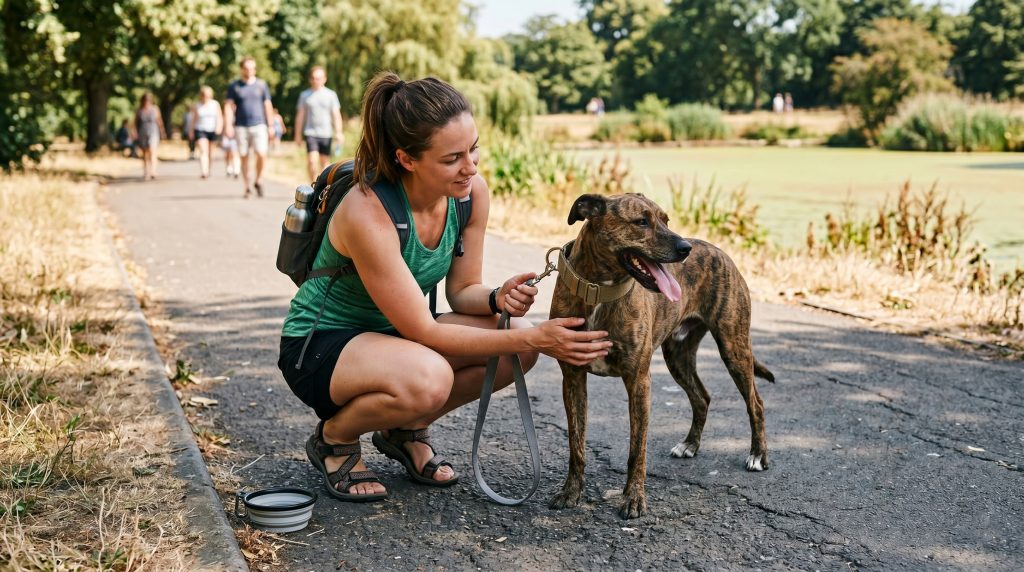
Summer dog safety sounds simple until a routine walk turns into a problem fast. Most owners know to avoid obvious extreme heat, but the real hazards usually show up in ordinary moments: a sidewalk that is hotter than it looks, a dog that keeps going until it suddenly can’t, a patch of grass full of ticks, or a pond that seems refreshing but isn’t safe.
If you want to keep your dog safer this season, it helps to think beyond “bring water” and look at the full picture. Here are five hidden summer hazards for dogs that catch owners off guard — and what to do instead.
1) Heatstroke starts before most owners realize their dog is in trouble
Dogs do not handle heat the way humans do. We sweat efficiently across most of our bodies. Dogs rely mainly on panting, limited sweating through their paw pads, and behavioral tricks like seeking shade or lying on cooler surfaces. That means they can get into trouble faster than many owners expect, especially during walks, play sessions, car rides, and outdoor errands.
Early signs of heat stress can be easy to dismiss at first. Your dog may start panting harder than usual, drooling more, slowing down, looking for shade, or stopping to sit or lie down. Some dogs become restless or anxious before they become weak. If the body temperature keeps rising, things can escalate into a medical emergency.
Warning signs that need immediate veterinary attention include disorientation, excessive drooling with thick saliva, abnormal gum or tongue color, vomiting, collapse, lethargy, or seizures. If your dog suddenly seems “off” in hot weather, it is safer to assume the heat is part of the problem and act quickly.
The practical takeaway is simple: do not wait for a dramatic collapse before taking heat seriously. If your dog is struggling, the outing has already gone too far.
2) Hot pavement can burn paws fast — and it also adds to heat overload
One of the most common summer mistakes is judging the ground by air temperature alone. Pavement, asphalt, artificial turf, sand, concrete, and metal can all get much hotter than the surrounding air. A day that feels manageable to you can still create dangerous walking surfaces for your dog.
According to AKC guidance cited from JAMA data, when the air temperature reaches 86°F, asphalt can reach around 135°F. AKC’s general advice is that when temperatures are 85°F or higher, and the ground has not had a chance to cool down, it may be too hot for safe walks on pavement.
A useful rule is the 10-second test: place the back of your hand on the pavement for 10 seconds. If that is uncomfortable for you, it is too hot for your dog’s paws. Burned pads are bad enough on their own, but hot ground also raises overall body temperature and increases heatstroke risk.
Safer options include walking early in the morning, later in the evening, sticking to shaded grass routes, or swapping a long walk for a short potty break plus indoor enrichment.
3) Overexercise in summer sneaks up on active dogs
A dog that wants to keep moving is not necessarily a dog that is coping well. Many dogs will continue walking, running, or playing long past the point where the heat is becoming unsafe. That is why summer overexercise catches people off guard: the dog looks willing, until it suddenly looks exhausted.
Warm-weather exercise can be especially risky for overweight dogs, senior dogs, puppies, brachycephalic breeds, and dogs with thick coats. Humidity makes the problem worse because it reduces how effectively panting can cool the body.
AVMA recommends avoiding walks, runs, and hikes during the hottest parts of the day, taking frequent breaks, and bringing enough water for both you and your dog. Even on days that do not seem brutally hot, long sun exposure and sustained activity can push a dog past a safe limit.
In practical terms, summer is not the best season to test endurance. It is the season for shorter walks, slower sniff-heavy outings, more breaks, and better judgment.
4) Ticks and other warm-weather parasites are not just a deep-woods problem
Tick risk climbs in warm weather, and owners often underestimate where exposure happens. It is not only a hiking trail issue. Dogs pick up ticks in parks, grassy verges, suburban yards, trail edges, and everyday walking routes.
The CDC recommends checking pets daily for ticks, especially after they spend time outdoors. Daily checks help remove ticks before they stay attached longer, and they also reduce the chance of ticks making their way indoors. The CDC also notes that dogs are very susceptible to tick bites and tickborne disease, and that using a tick preventive product is an important part of protection.
Beyond ticks, AVMA also reminds owners that warm weather raises the importance of parasite control more broadly, including fleas and heartworm. So this is a good seasonal checkpoint: if your dog’s preventive routine has gotten loose, summer is when that gap matters more.
After walks, do a quick scan around the ears, collar area, neck, under the legs, between the toes, and around the tail. It only takes a minute, and that minute is worth a lot.
5) Lakes and ponds can look like a relief while hiding a serious toxic risk
When the weather heats up, water seems like the obvious answer. But not every pond or lake is safe for dogs. Blue-green algae, also called cyanobacteria, becomes more likely in warm, sunny conditions, especially in stagnant or slow-moving freshwater.
ASPCA warns that dogs can be exposed by drinking contaminated water, swimming in it, or even licking algae off their fur afterward. Toxic blooms may look like green scum, slime, or paint floating on the surface, and wind can push it toward shorelines where dogs are most likely to drink or wade.
Blue-green algae exposure can lead to severe neurologic or liver damage. Symptoms may include panting, drooling, vomiting, diarrhea, disorientation, seizures, or respiratory distress. If there is any chance your dog has been exposed and starts showing symptoms, treat it like an emergency.
The safest move is prevention: do not let your dog drink from questionable water, bring fresh water from home, and rinse your dog with clean water after swimming if the water quality is uncertain.
When should you skip the walk entirely?
Sometimes the safest summer walk is the one you do not take.
It is smart to skip, shorten, or reschedule the outing if:
- The pavement fails the 10-second hand test
- Your dog is panting hard almost immediately
- The route has little shade and lots of reflected heat
- The humidity is high, and the air feels heavy
- Your dog is a puppy, senior, overweight, flat-faced, or heavy-coated
- Your dog starts lagging, sitting down, or refusing to continue
Skipping a walk does not mean skipping your dog’s needs. It just means meeting those needs more intelligently. On very hot days, a short early potty trip, indoor training, food puzzles, scent games, and calm enrichment are often the better call.
A safer summer walking setup matters too
Summer walks also come with more distractions: wildlife, bikes, scooters, kids, other dogs, neighborhood activity, and sudden noises. That makes equipment choice part of the safety conversation, too.
A properly fitted martingale collar will not solve heat risk, but it can be part of a safer summer-walk setup. For dogs who are prone to backing out of flat collars, a martingale offers a more secure fit for early-morning walks, shorter training outings, and those overstimulated moments when a startled dog might otherwise slip free. That extra security can matter when you are choosing shorter, more controlled walks during busy summer months.
Final thought
The biggest summer dog hazards are often the ones that do not look dramatic at first. A normal walk, a warm sidewalk, an eager dog, a quiet pond, or a quick loop through the park can all become risky faster than owners expect.
The good news is that most of these problems are preventable. Walk earlier. Shorten the outing. Check the ground. Watch your dog, not just the forecast. Bring water. Stay on top of parasite prevention. And when conditions feel questionable, trust that instinct and skip the walk.
Sources
- American Kennel Club (AKC): How Hot Is Too Hot for a Dog’s Paws?
- American Kennel Club (AKC): Is the Weather Too Hot For Your Dog? Watch For These Signs
- American Veterinary Medical Association (AVMA): Warm weather pet safety
- Centers for Disease Control and Prevention (CDC): Preventing Ticks on Pets
- ASPCA: Pet Safety Alert: The Rising Dangers of Blue-Green Algae