Your dog falling asleep in the middle of the day is not a productivity failure. It is not laziness, and it is not proof that you are failing to keep life interesting. For many owners, the harder habit is not finding more stimulation. It is learning to notice when the dog has already stepped out of the action and chosen a quiet moment instead.
That matters because rest is not empty time. Sleep researchers studying family dogs describe distinct phases including wakefulness, drowsiness, non-REM sleep, and REM sleep, which tells us that canine sleep is a real, measurable part of ordinary physiology, not just “switching off” between activities (Bálint et al., 2019). In other words, rest belongs in a dog’s day.
What the evidence does not give us is a magic number that every dog should hit. The validated research package for this brief is deliberately narrow, and that is useful. It supports a modest point: daytime rest can be normal, and sleep quality can matter, but it does not support a universal daily sleep target, a perfect nap schedule, or sweeping claims about what more rest will fix.
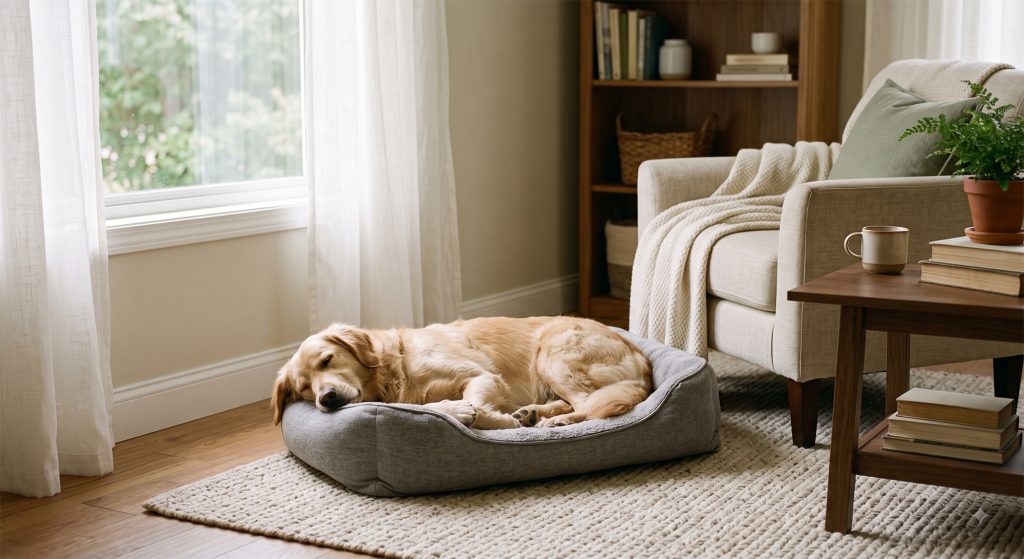
One of the studies in the package observed dogs during three-hour afternoon nap recordings (Reicher et al., 2021). That does not mean every dog needs a three-hour nap, or that afternoon is somehow the correct time for all dogs to sleep. It simply supports the common-sense idea that many dogs do rest during the day. If your dog settles after a walk, after visitors leave, or while the household gets quieter, that may be normal canine downtime rather than a problem asking to be interrupted.
This is why a fixed daily sleep target is not the point. Dogs are individuals living in real homes, not identical machines following the same chart. A useful owner response is not to hover with a stopwatch. It is to notice patterns. When does your dog naturally soften, stretch out, curl up, or move to a familiar quiet place? When do they seem most interested in being left undisturbed?
That kind of observation is more practical than turning rest into another performance metric. It also keeps the tone of care where it belongs: gentle, attentive, and specific to the dog in front of you.
Rest-Friendly Home
- Let a settled dog remain settled when practical instead of automatically calling them back into activity.
- Keep a predictable quiet spot available, so rest does not depend on the house accidentally becoming calm.
- Ask household members to notice when the dog has chosen to disengage, especially in busy homes where someone is always tempted to restart the fun.
- Observe usual rest patterns over time rather than trying to self-diagnose from one sleepy afternoon.
None of those steps pretends to control sleep. They simply make room for it.
That is important because owners can accidentally frame rest as a problem to solve. A dog lies down, and we wonder if we should add another game, another walk, another toy, another interruption. Sometimes more activity is appropriate. Sometimes the better move is to do nothing dramatic at all. If the dog is settled, comfortable, and following a familiar rhythm, leaving that quiet moment alone can be a form of care.
There is also a limit to how much meaning we should force onto a single nap. A dog resting today is not automatically bored, unhappy, or unwell. Just as importantly, an article like this should not swing to the opposite extreme and tell you that every change in rest is harmless. The evidence in the validated package includes work showing that disturbed sleep can matter in a clinical context, which is why the brief keeps a clear professional boundary (Barker et al., 2021).
So when is a change worth raising with a vet? The safest answer is also the simplest one: if your dog’s sleep or rest changes markedly, stays different, becomes unusually restless, or worries you, ask your vet. That boundary matters more than any internet nap chart. It respects what the evidence actually supports, and it avoids turning ordinary owner observation into amateur diagnosis.
Most of the time, though, the better question is not “How do I make my dog more active right this second?” It is “What is my dog showing me about this part of the day?” Some dogs crash hard after stimulation. Some drift in and out of calm near their people. Some seek the same corner every afternoon. Those rhythms are worth noticing because they tell you how your dog inhabits your home when nothing special is being asked of them.
The gentlest version of good care is often less interventionist than we expect. Keep a calm place available. Notice when your dog has checked out of the social moment. Resist the urge to make every quiet spell productive. And if the pattern changes in a marked or persistent way, or something about it feels off, bring that observation to your vet.
The dog in front of you does not need to win a nap quota. They need you to recognize that rest is part of a dog’s day too.